
Want to switch on a light or ceiling fan from somewhere there’s no wiring? Maybe beside the bed, on a brick feature wall, or at the other end of a long room? A kinetic switch might be the answer.
They’re simple, clever and surprisingly handy for both lights and fans. But there’s one part of the job that still needs a licensed electrician in NSW. Here’s how they work, what’s involved and what you can expect to pay.
What Is a Kinetic Switch?
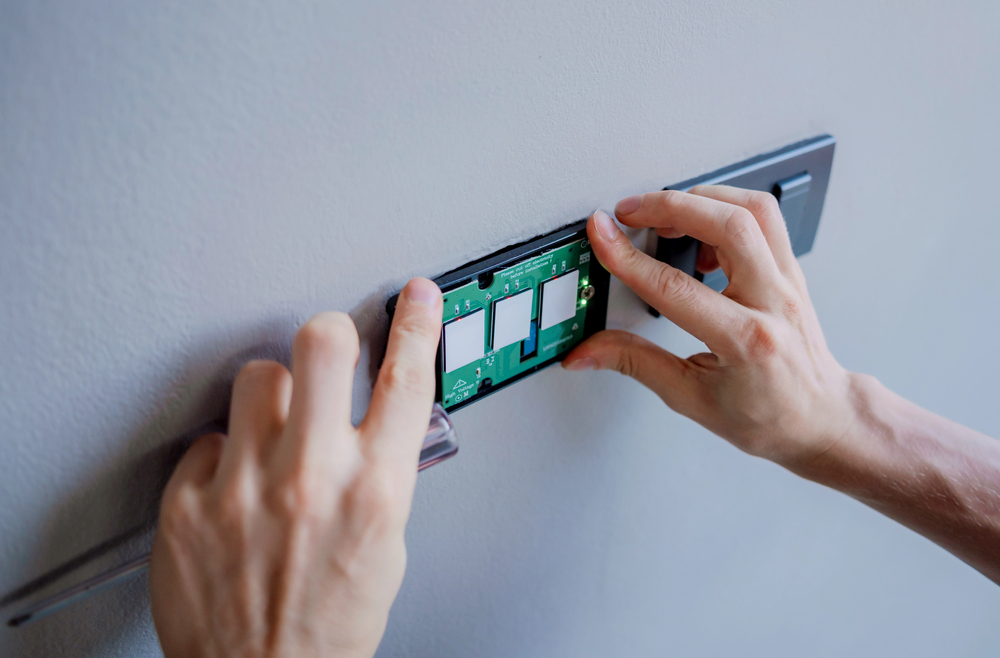
A kinetic switch is a wireless wall switch that powers itself. There’s no battery and no cable running to the wall plate.
It looks like a normal switch and sticks or screws onto almost any surface: plasterboard, brick, tiles, timber or glass. Pair it with the right receiver and it can control:
- Lights, including downlights, pendants and oyster lights
- Ceiling fans, switching them on and off and, with some models, changing the speed
- Fan and light combos, with separate buttons for each
How Do Kinetic Switches Work?
Think of it like a bike dynamo. Pedalling makes power for the light. Pressing a kinetic switch does the same thing, just on a much smaller scale.
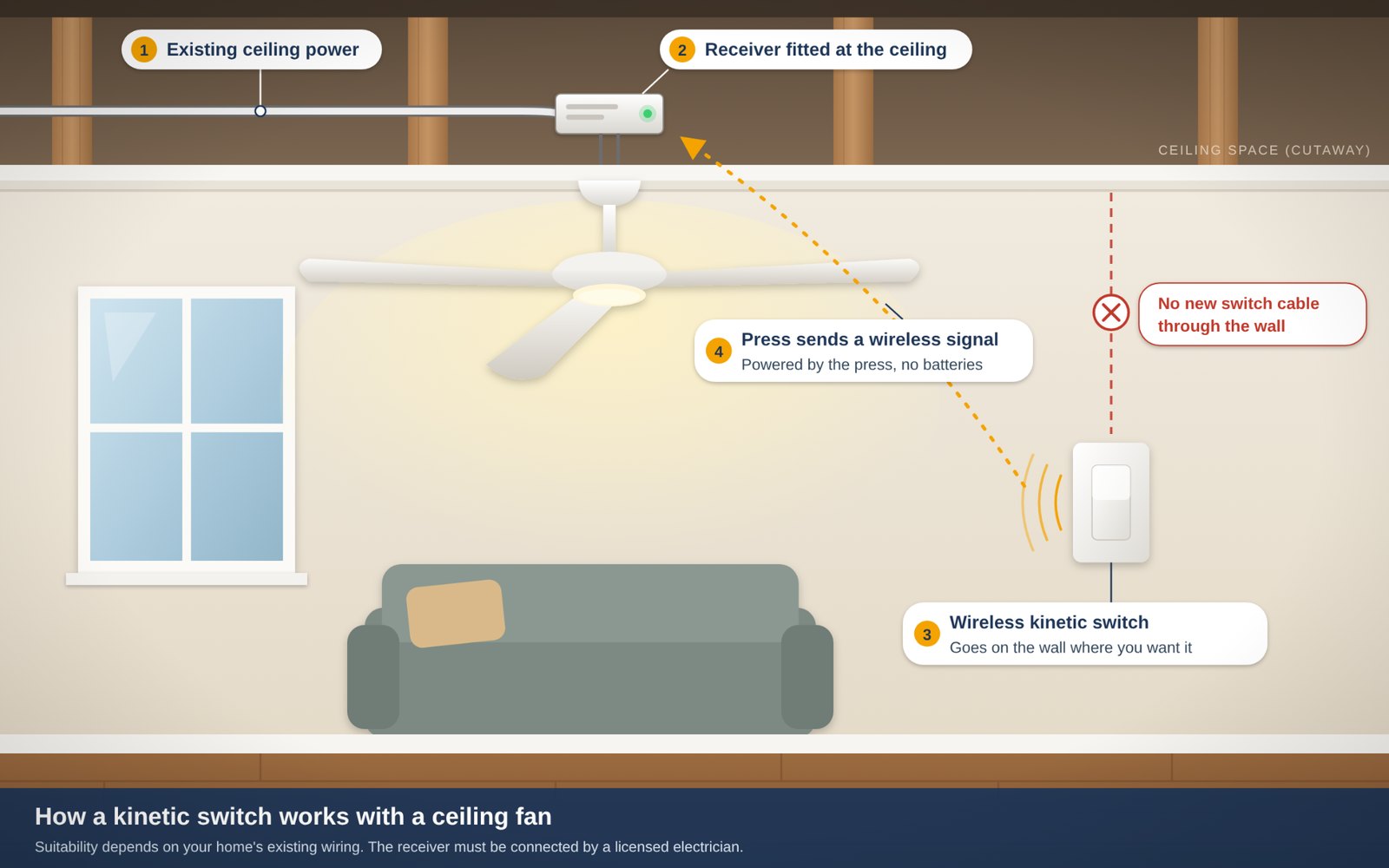
Here’s the process in three steps:
- You press the switch. The movement drives a tiny generator inside the switch.
- It sends a signal. That little burst of energy is enough to send a radio signal.
- The receiver does the work. A receiver, wired into the circuit (usually in the ceiling, or at the light or fan), picks up the signal and turns the light or fan on or off.
So the switch on the wall is just a messenger. The receiver is the part actually connected to your 230V power, and that’s the bit that matters for safety and the law.
Lights vs ceiling fans: what’s different?
The switch is the same. The receiver isn’t.
- Light receivers handle simple on/off or dimming for lighting loads.
- Fan receivers are built for motors. A fan motor draws power differently to a light, so a standard light receiver can buzz, overheat or fail when used on a fan.
- Fan speed control needs a receiver designed for it. A multi-button switch can then give you off, low, medium and high.
- DC fans often run on their own built-in controller and remote. Not all of them work with third-party kinetic receivers, so check compatibility first.
This is one of the main reasons the receiver choice should be left to your electrician.
Why People Choose Kinetic Switches
For homeowners:
- Add a light or fan switch without chasing walls or cutting into plaster
- Great for heritage homes where you’d rather not damage original walls or cornices
- Bedside control for the fan and light, so you’re not getting up on a hot night
- Separate light and fan buttons on one neat plate
- Two-way switching for stairs, hallways and large living areas
- No batteries to replace and no remote to lose down the couch
For businesses:
- Move light and fan switches when you rearrange a fit-out or office layout
- Add switches to glass partitions or feature walls
- Control fans in cafés, waiting rooms and open-plan offices from where staff actually need them
- Faster installs with less disruption to trading
- Fewer wall repairs and less mess
Things to keep in mind:
- Range drops through thick brick, concrete and metal, so placement matters
- Not every receiver suits every light or fan, especially dimmable LEDs and DC fans
- Cheap, uncertified products can be unreliable or unsafe
Do You Need an Electrician to Install a Kinetic Switch in NSW?
Yes, for the receiver, whether it’s running ceiling fan or lighting installation in Sydney or the entire NSW state.
The wall switch itself has no mains power, so sticking it to the wall isn’t electrical work. But the receiver connects directly to the light or fan circuit. That’s electrical wiring work, and in NSW it must be done by a licensed electrician.
Here’s what the rules say:
- Licensed work only. Under the Home Building Act 1989 (section 14), electrical wiring work must be done by a licensed electrician, or by someone working under their direct supervision. Unlicensed work can attract penalties of up to 200 penalty units for individuals and 1,000 for businesses.
- A compliance certificate is required. After the work is tested, your electrician must lodge a Certificate of Compliance for Electrical Work (CCEW) with Building Commission NSW within seven days. You should get a copy too.
- It must meet Australian standards. The installation must comply with the Wiring Rules (AS/NZS 3000).
Why it matters beyond the law: DIY wiring can void your home insurance, cause problems when you sell or lease, and create a fire or shock risk. A small receiver tucked away in the ceiling is easy to forget about, which is exactly why it needs to be done right. With fans, the wrong receiver can also cook itself or damage the motor over time.
What’s Involved in Installing a Kinetic Switch?
A good install is quick, but there are a few boxes to tick.
1. Check the product is approved
Electrical products sold in Australia should carry the RCM (Regulatory Compliance Mark). Overseas kits bought online often don’t. Your electrician can recommend reputable brands or supply the parts.
2. Match the receiver to the light or fan
The receiver needs to suit:
- For lights: the type of light (LED, downlights, pendants), the total load and whether you want dimming
- For fans: the fan type (AC or DC), the motor load and whether you want speed control
- For combos: separate channels for the fan and the light
Getting this wrong is the most common cause of flickering lights, humming fans or fans stuck on one speed.
3. Find a spot for the receiver
It needs to sit somewhere safe and accessible, usually in the ceiling space near the light or fan, or inside a compatible fitting or fan canopy. It must be protected and installed to the Wiring Rules.
4. Wire, pair and test
The electrician turns off the power, wires in the receiver, then pairs it with your switch (usually a button press on each). They test every function, including each fan speed, check the circuit is safe and lodge your CCEW.
5. Place the switch
The final step is the easy one. Pick a spot within range, test it there first, then fix the switch to the wall.
How Much Do Kinetic Switches Cost?
Costs depend on the product, whether it’s for a light or a fan, how many switches you need and how easy it is to access the ceiling. As a rough guide for Sydney:
| Item | Typical cost |
| Kinetic switch (wall unit) | $50 to $150 each |
| Light receiver | $40 to $150 each |
| Fan receiver (on/off or speed control) | $80 to $200 each |
| Electrician call-out fee | $60 to $170 |
| Electrician hourly rate | $90 to $170 per hour |
| Installed price, light switch and receiver | around $200 to $450 |
| Installed price, fan switch and receiver | around $250 to $550 |
| Each extra switch on the same visit | around $120 to $300 |
What pushes the price up:
- Tricky ceiling access (low roof space, tight crawl spaces, no manhole)
- Fan speed control or combined fan and light receivers
- Dimmable or smart/Wi-Fi compatible models
- Multi-gang switches controlling several lights or fans
- After-hours or weekend work
- Commercial sites with larger loads
What keeps it down:
- Bundling several lights and fans into one visit
- Easy ceiling access
- Choosing a quality mid-range brand
Prices are indicative only. Always ask for a fixed quote before work starts.